
Too Shallow, Too Deep, and the Path Between
Two people look at AI and walk away for opposite reasons. Both of them are wrong, and they made the same mistake.
The first one tried it. They opened ChatGPT, asked it to clean up an email or summarize an article, and it worked. Handy. A faster search, a better first draft when the page is blank. They filed it away as a useful little utility and moved on, and if you ask them, they will tell you they already know how to use AI. They do. They know the shallow version, and they have no idea there is a gear above it.
The second one heard the other conversation. Agents, building your own stack, custom tooling, the language of people who write code for a living. They listened for a minute, concluded the whole thing was for engineers, and decided they were not technical enough to play. They are right that they do not want to build any of that. They are wrong about what it means.
One looked at the shallow end and thought it was the whole pool. The other looked at the deep technical end and thought it was the only serious way in. Both mistook one end of a road for the entire road.
The Two Ends
It helps to name both ends plainly, because once you can see them, you can see what is between them.
At one end, AI is a utility. You poke it, it gives you something, you take it or you do not. This is real, and it is fine as far as it goes. It is also the least of what the tool can do, and it is where most experienced people stop, because it works well enough to feel like the answer.
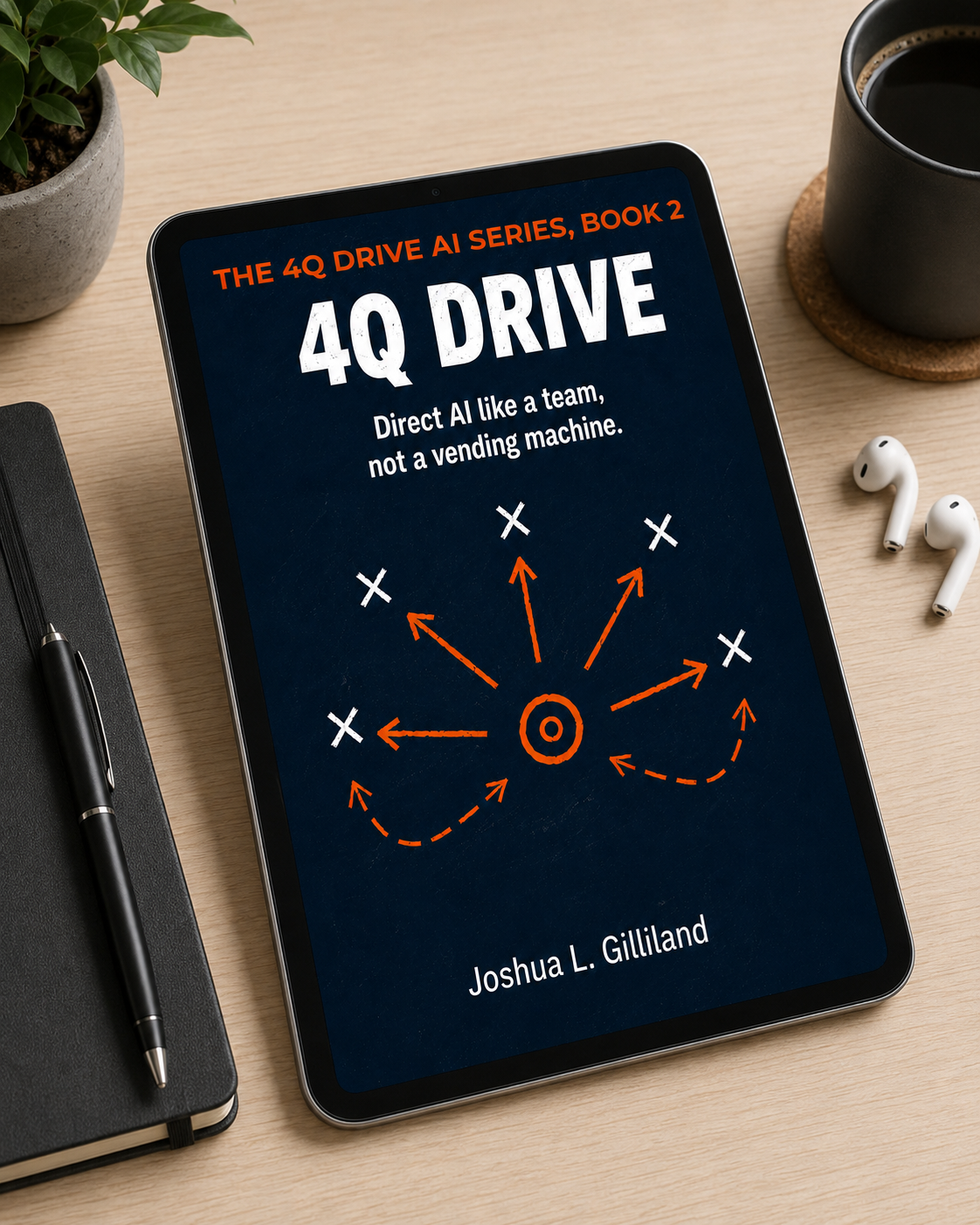
4Q Drive: Director, Not Vending Machine
$20 — book and workbook
The method at the center of the catalog.
Most people get thin results from AI because they use it like a vending machine: press a button, take what drops out, decide the tool is overhated. You never ran your teams that way. You told people what the work was for, what good looked like, and the context they could not have known, then you read the draft and redirected. That is direction, and it is the difference between a customer at a machine and the person running the work.
4Q Drive is the book that turns that instinct into a repeatable method. The Six-Step Operating Pattern for briefing AI the way you briefed capable people. Positive Friction, the discipline of building checks into the process so a confident answer still has to earn its place. The reframe is simple: AI is not the vending machine, it is the new hire that does remarkable work when you direct it like one. The skill it runs on is not technical. It is the judgment you spent a career building.
This is for the experienced program or project manager who has briefed real teams and suspects, correctly, that the same judgment is what directs AI well.
Inside 4Q Drive
The director stance: why treating AI as a team you direct beats treating it as a tool you poke, and what changes when you do.
The Six-Step Operating Pattern: mission, context, role, output, iteration, and turning the result into an asset.
Positive Friction: how to instruct the team to push back on you, so the output sharpens your judgment instead of eroding it.
Contents
Chapter 1: Director, Not Vending Machine Operator
Chapter 2: Your Team Is Already Trained for You
Chapter 3: Why This Works
Chapter 4: The Six-Step Operating Pattern
Chapter 5: Mission and Context
Chapter 6: Role and Output
Chapter 7: Iterate with Taste, Turn the Result into an Asset
Chapter 8: Positive Friction
Chapter 9: The Four Operational Tensions
Chapter 10: The Director's Mindset
What you get
The complete book in EPUB and PDF.
The 4Q Drive workbook, which runs the Six-Step Operating Pattern on your own work instead of leaving it as something you agree with and never apply.
A guide to the full 4Q Drive system, showing how all five books fit together.
At the other end, AI is something you engineer. You build platforms, you wire up infrastructure, you write and maintain code. This is also real, and it is genuinely powerful. It is also technical work, a different profession, and not something most experienced operators want to become or need to. The mistake here is not wanting to avoid it. The mistake is believing it is the bar, that anything short of building the machine yourself is just dabbling.
Both ends are real. Neither is where the work you actually want to do lives.
The Path Between
In between is a third way of relating to AI, and it is the one almost nobody names, which is exactly why most people miss it.
You direct AI like a team. Not a utility you poke, and not a system you build. A set of capable workers you brief, assign, review, and redirect, the way you ran people for years. It is more sophisticated than the utility, because you are getting real work out of it rather than quick favors. And it requires no engineering at all, because you are the operator giving direction, not the coder building the worker. The skill it runs on is not technical. It is judgment, the thing you already spent a career building.
That is the whole reframe, and notice what it does to both mistakes at once. To the person who says "I already know AI," it says there is a level above the utility you settled for, and that level is where the practice actually gets built. To the person who says "I am not technical enough," it says the engineering end was never the bar, and the path that fits you asks for exactly the operator's judgment you already have.
One frame, both objections answered. You are not behind, and you are not locked out. You were standing in one of the two ditches, looking at the wrong end of the road, when the part built for you was the stretch in the middle the whole time.
The middle path is the whole premise of 4Q Drive: directing AI as a team you run, on the judgment you already have, with none of the engineering. If it lands, the free guide names the corporate reflexes that get in the way when experienced people start directing AI, and the catalog is the full system built on this path.
Josh
Founder, 4Q Drive
