
Director, Not Vending Machine
You tried AI on something real. You asked it to write the proposal, or summarize the report, or draft the plan. What came back was fine. Generic, a little hollow, the kind of thing you would rewrite before anyone saw it. You did this a few times, decided the hype was overblown, and went back to doing it yourself.
Here is what was actually happening. You were using AI like a vending machine.
You walk up to a vending machine, press a button, and take what drops out. The transaction is complete in one move. There is no context, no back and forth, no standard you set in advance. "Write me a proposal" is a vending-machine request, and a vending machine is exactly what answers it: something generic, because generic is all a one-line request can produce.
That is not a limit of the tool. It is a limit of how the tool was asked.
You Already Know the Better Way
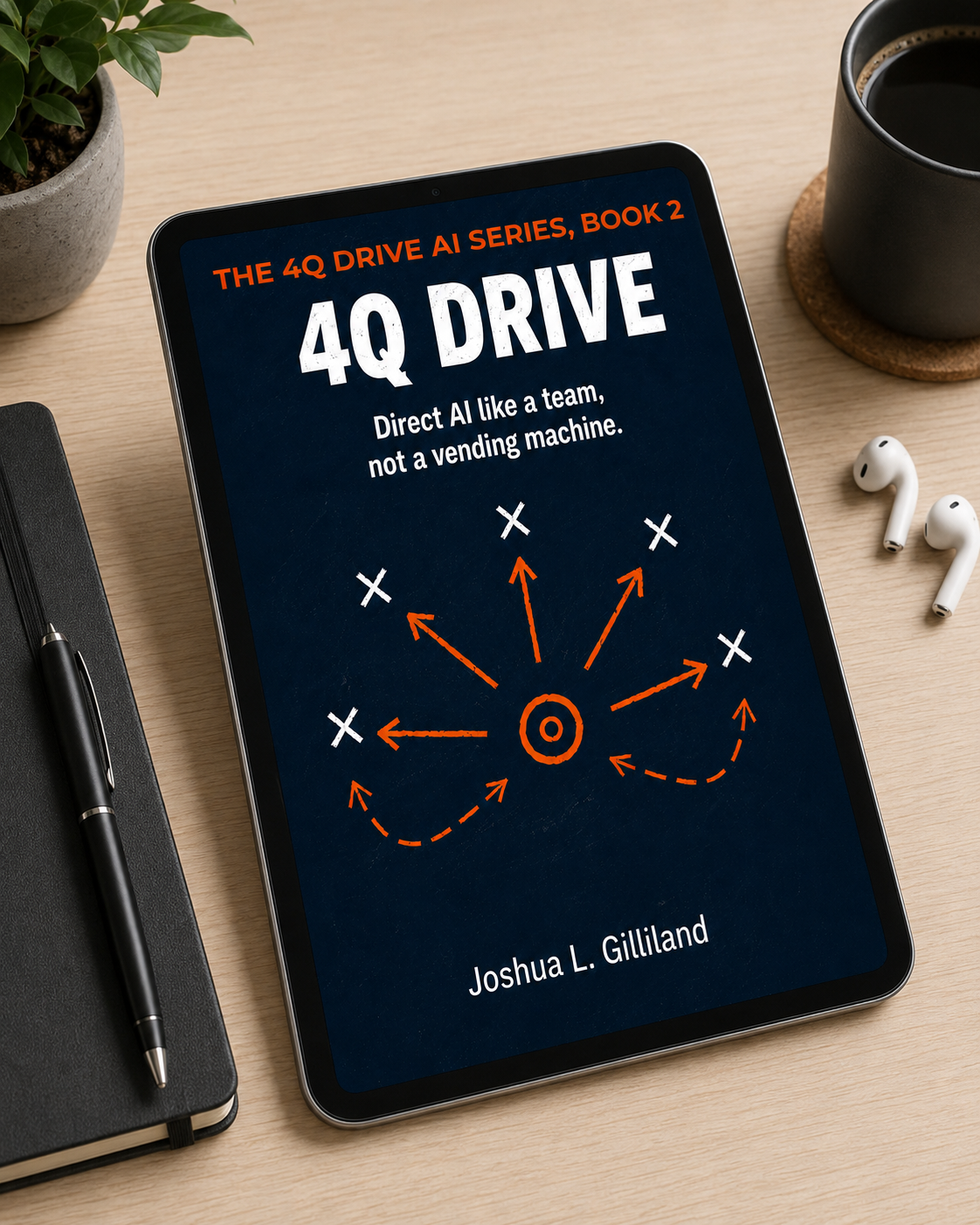
4Q Drive: Director, Not Vending Machine
$20 — book and workbook
The method at the center of the catalog.
Most people get thin results from AI because they use it like a vending machine: press a button, take what drops out, decide the tool is overhated. You never ran your teams that way. You told people what the work was for, what good looked like, and the context they could not have known, then you read the draft and redirected. That is direction, and it is the difference between a customer at a machine and the person running the work.
4Q Drive is the book that turns that instinct into a repeatable method. The Six-Step Operating Pattern for briefing AI the way you briefed capable people. Positive Friction, the discipline of building checks into the process so a confident answer still has to earn its place. The reframe is simple: AI is not the vending machine, it is the new hire that does remarkable work when you direct it like one. The skill it runs on is not technical. It is the judgment you spent a career building.
This is for the experienced program or project manager who has briefed real teams and suspects, correctly, that the same judgment is what directs AI well.
Inside 4Q Drive
The director stance: why treating AI as a team you direct beats treating it as a tool you poke, and what changes when you do.
The Six-Step Operating Pattern: mission, context, role, output, iteration, and turning the result into an asset.
Positive Friction: how to instruct the team to push back on you, so the output sharpens your judgment instead of eroding it.
Contents
Chapter 1: Director, Not Vending Machine Operator
Chapter 2: Your Team Is Already Trained for You
Chapter 3: Why This Works
Chapter 4: The Six-Step Operating Pattern
Chapter 5: Mission and Context
Chapter 6: Role and Output
Chapter 7: Iterate with Taste, Turn the Result into an Asset
Chapter 8: Positive Friction
Chapter 9: The Four Operational Tensions
Chapter 10: The Director's Mindset
What you get
The complete book in EPUB and PDF.
The 4Q Drive workbook, which runs the Six-Step Operating Pattern on your own work instead of leaving it as something you agree with and never apply.
A guide to the full 4Q Drive system, showing how all five books fit together.
Think about how you actually got strong work out of people across your career. You did not walk up to a capable colleague and say "write me a proposal" and walk off. You told them what it was for and who would read it, what a good one looked like and what a weak one looked like, and the context they could not have known unless you said it. Then you looked at the draft and told them what to change, and they went back and made it better.
That is direction. It is the difference between a customer at a machine and the person running the work. And it is a skill you already have, because you spent years building it on people.
The reframe at the center of all this is simple. AI is not the vending machine. It is the new hire who will do remarkable work if you brief and direct it like one, and forgettable work if you treat it like a snack dispenser. The people getting thin results are not using a worse tool than you. They are pressing buttons. The people getting real work are directing.
The Part That Makes It Work
There is a second move that separates the two, and it is the one most people skip. When the machine hands back a confident, fluent answer, the button-presser takes it. The director does not. The director reads it the way they would read a sharp junior's first draft, looking for the assumption that is off, the claim that does not hold, the thing that sounds right and is not.
We call that Positive Friction: the deliberate checks you build into the process so that a confident answer still has to earn its place. It is not distrust of the tool. It is the same judgment you used to apply to your own team's work, pointed at a new kind of worker. The vending machine gives you speed. The friction is what makes the speed safe to use.
You do not need to learn to think like an engineer to get this. You need to do what you already did for years, point your judgment at the work and direct it, with the one adjustment that the thing you are directing is a model instead of a person.
Director versus vending machine is the foundation of 4Q Drive, the methodology book in the catalog. If it is useful, the free guide names the corporate reflexes that quietly get in the way when experienced people start directing AI.
Josh Founder, 4Q Drive
