
Judgment Is the Controls, Not the Consolation Prize
A Stanford lecturer made a case worth your time, and worth building on.
In Fast Company, Matt Abrahams argued that in the age of AI, your most human skills are what will set you apart. As machine-made content floods everything and the quality of it drops, the qualities that mark a real person, what he calls Old School AI, Authenticity and Influence, are what people will still trust and remember. His advice is to stop trying to out-AI the AI and lean into what only a human can do.
He is right, and it is not a small point. It is the same premise a whole way of working rests on: experienced people should stop competing on tool fluency. That is the race they cannot win against someone who has been prompting since college, and it is the wrong race anyway. The human advantage is real.
Here is the part worth adding.
Abrahams's argument lands as human instead of machine. As AI rises, move toward the human corner, the place the machine cannot follow. That instinct is sound as far as it goes. But for anyone actually building something, a practice or a business of their own, the stronger version is human plus machine. Your judgment is not only the thing AI cannot replicate. It is the thing that lets you direct AI better than the people racing to out-prompt each other.
You Cannot Actually Retreat to the Corner
Retreating to the human-only corner is not available to someone building a practice, because the practice will run on AI. The proposals, the research, the first drafts, the analysis, the day-to-day operations of a one-person firm doing what used to take a team, all of it runs on the tool. You do not get to opt out of the machine and still build the thing.
So the question was never whether you touch AI. It is whether you command it or get buried under its output like everyone else. Standing in the corner does not make you the operator. It makes you a spectator with good manners.
His Own Framework Gives It Away
Here is where Abrahams's own framework becomes the most useful thing in his piece.
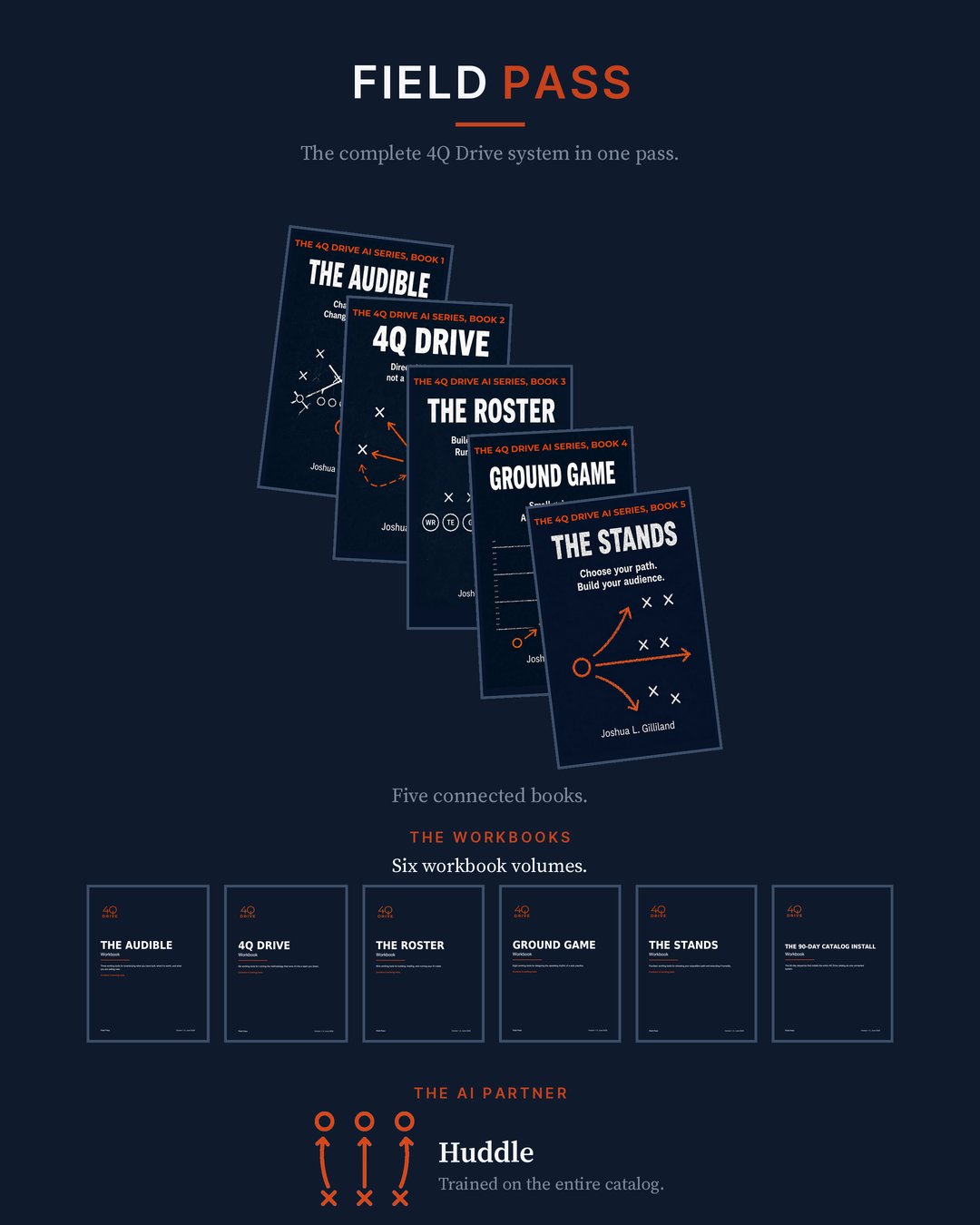
The Complete Set: The Whole 4Q Drive System
$80 — all five books, all five workbooks, and Huddle
Five books is information. The reason the system works is everything around them.
The Complete Set is the entire 4Q Drive catalog in one place. The five books, read as one connected operating system. The full workbook library that turns each method from something you understand into something you run. The 90-day install sequence that builds the catalog in a compounding order instead of a pile. And Huddle, the AI operating partner trained on the whole catalog, so the framework is in the room every time you sit down to work.
Bought as separate book-and-workbook packages, the catalog runs to more than the price of the set. You are buying it as one connected system, for less than the sum of the parts, and with Huddle included only here.
What is inside
The five books, in EPUB and PDF. The Audible sets the worldview. 4Q Drive is the method, director not vending machine. The Roster builds the team of AI agents you direct. Ground Game builds the operating rhythm that sustains the work. The Stands is how the right buyers come to know you exist.
The full workbook library. The working tools, anchored to the chapters. Not worksheets you fill out and file away. Each one drives toward an artifact you can run from.
The 90-Day Install. The sequence that turns the whole catalog into one ordered build, so you install it in a compounding order instead of drowning in it.
Huddle, your AI operating partner. A Custom GPT trained on the entire catalog, so every answer it gives connects to the same framework you are learning. Runs on a free ChatGPT account. Included with the Complete Set, and not sold separately. You receive Huddle as it stands today.
Why this is a system, not a reading list
The books are the thinking. The workbooks are where the thinking becomes work you can run, the difference between understanding the Six-Step Operating Pattern and actually running it on your own practice. The install sequence keeps the whole catalog from sitting unread by handing you one ordered path. Huddle keeps the framework in the room after the reading is done. Every piece points back to the same foundation and the same vocabulary. That connective tissue is the product. Anyone can write five books. The system is what turns them into a practice.
What you get
The complete current catalog, yours to keep: five books, five workbooks, the 90-day install sequence, and Huddle as it stands today. One purchase. No subscription, nothing to cancel.
Immediate download.
He tells you to define your goal, your audience, and your context before you craft any message, and to structure what you say through a simple pattern: What, So what, Now what. He is describing the discipline of communicating well to a person. Decide what you are trying to accomplish, who you are speaking to, and what they need to know, before a single word goes out.
Now look at what it takes to get real work out of AI. You give it the mission, what you are trying to accomplish. You hand over the context it cannot know unless you tell it. You assign it a role, who it is being for this task. And you describe what good output looks like, so it has something to aim at. Mission, context, role, output.
Those are the same instructions. The goal-audience-context that Abrahams says makes a human persuasive is, almost line for line, the briefing you hand a capable AI. The What, So what, Now what that organizes a clear message is the same judgment that organizes a clear brief. He has described, without naming it as such, the exact skill that separates someone who directs AI from someone who pesters it.
That is the connection worth holding onto. The judgment that lets you brief a person is the judgment that lets you brief a model. You spent a long career learning to walk into a room, read who was in it, and tell people what mattered and why, in the order they needed to hear it. That is not a soft skill you fall back on once the machine takes the hard ones. It is the control surface. It is what lets you sit in the director's chair instead of standing at the vending machine, pressing buttons and hoping.
The Edge Is Bigger Than Standing Apart
So the human edge in the age of AI is larger than it first looks, and more useful. It is not only what the machine cannot do. It is what lets you run the machine. The experienced person's advantage was never going to be hiding in the corner the AI cannot reach. It was always going to be picking up the controls that the people racing on tool fluency never learned to hold.
Credit to Abrahams for naming the human edge so clearly. The piece worth adding is that the same edge does double duty. It is what makes you trusted, and it is what makes you able to direct the work. Judgment is not the consolation prize you are left with after AI takes the rest. It is the controls.
This is most of what we think about at 4Q Drive. If it is useful, the free guide on the five corporate reflexes names the habits that quietly get in the way when experienced people start directing AI, and the catalog is the full system behind it, the method for briefing and directing AI as a team you run rather than a machine you poke at.
Josh
Founder, 4Q Drive
