
Do Not Rebuild the Grind You Just Left
You can do the work of a whole team now. One experienced operator, directing AI, producing what used to take a department. That is the promise, and it is real. It also has a trap inside it, and the trap is quiet.
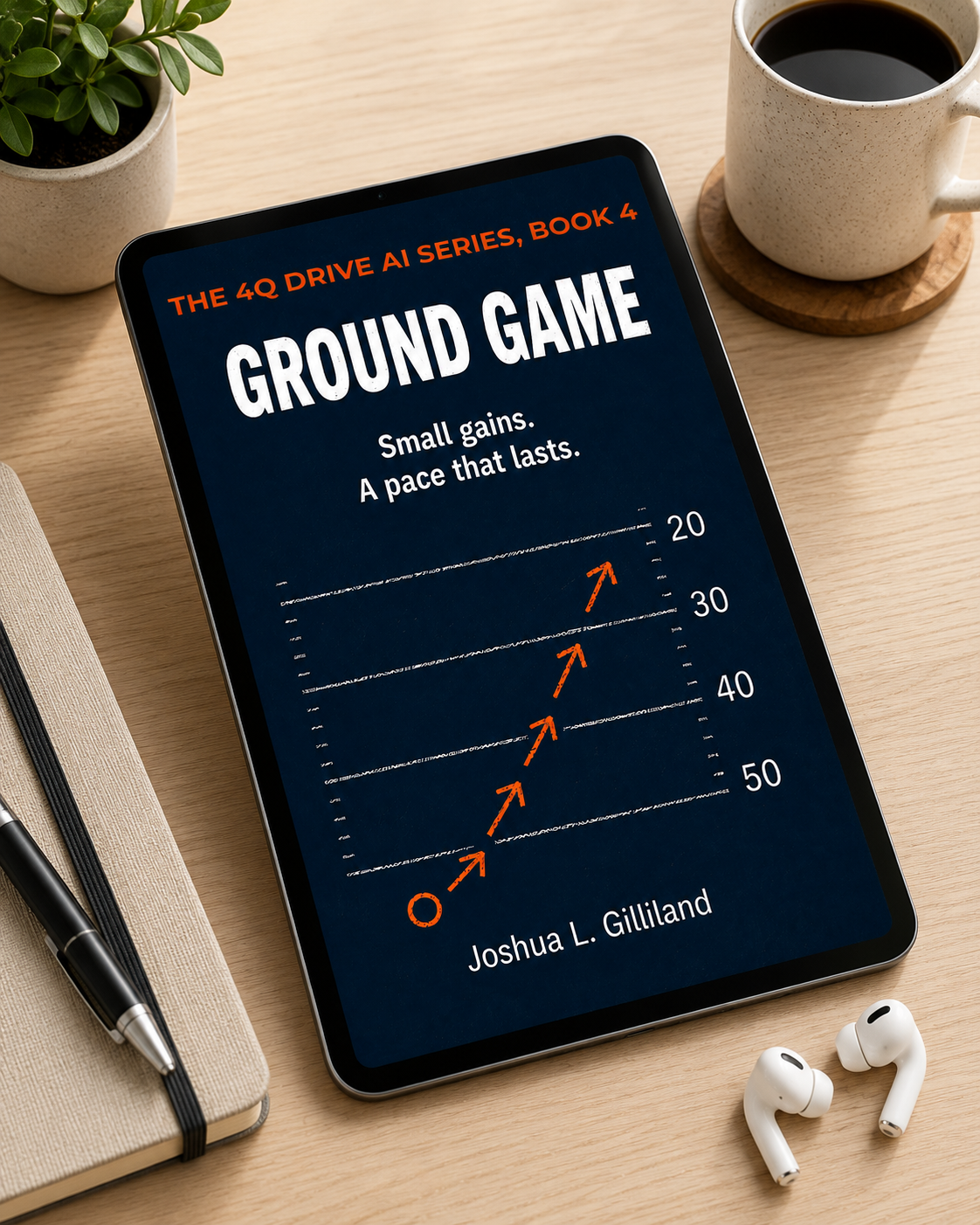
Ground Game: Do Not Rebuild the Grind You Just Left
$20 — book and workbook
The operating rhythm that keeps the practice from consuming the person running it.
You know the failure mode, because you may have lived it. You get out from under the grind, start building your own thing, and somehow you are busier than ever. The days fill. There is always another task. And one quiet evening it occurs to you that you have rebuilt the exact grind you left, except now there is no one else to blame for it.
Ground Game is the book on building a rhythm that does not do that. It starts from the honest constraint: one person has a finite number of high-judgment hours, the ones where your experience does the work only you can do, and those hours are the entire asset. The Dividing Discipline is the spine of it. Divide the work by what it actually requires. The calls that need your judgment get your protected hours, and nothing crowds them out. The drafting, the research, the first passes go to the team you direct, because that team can now carry them.
This is for the experienced operator who wants the practice to last years, not burn out in the first quarter.
Inside Ground Game
Why the operator is the bottleneck, and why corporate pace will quietly kill a solo practice.
The day, the week, and the month that actually work: rhythms that compound instead of fill.
The Dividing Discipline, attention residue, AI without burnout, and the discipline of saying no.
Contents
Section 1 — The Operator Problem
Chapter 1: The Operator Is the Bottleneck
Chapter 2: Why Corporate Pace Will Kill You
Chapter 3: The Ceiling You Can't Negotiate
Section 2 — The Rhythms
Chapter 4: The Day That Actually Works
Chapter 5: The Week That Compounds
Chapter 6: The Month That Resets
Section 3 — The Practices
Chapter 7: Attention Residue and the Cost of Switching
Chapter 8: AI Without Burnout
Chapter 9: The Discipline of No
Section 4 — The Long View
Chapter 10: Seasonal Variation
Chapter 11: The Failure Modes
Chapter 12: Ground Game
What you get
The complete book in EPUB and PDF.
The Ground Game workbook, which builds your actual operating rhythm and the Dividing Discipline around your real week.
A guide to the full 4Q Drive system, showing how all five books fit together.
Here is how it springs. You start directing AI, and suddenly the ceiling on what you can produce lifts. So you produce. The days fill. There is always another thing the machine could help you make, another task you can now take on, another output you can generate. And some quiet evening it occurs to you that you are busier than ever, that the leverage you gained went straight into more volume, and you have built yourself a grind out of your own capability.
This is the most common way it goes wrong. Not too few hours of work. Too many, spent on the wrong things, because the tool made it so easy to do more.
Capacity Is Real, and One Person Has a Ceiling
The leverage AI gives you hides your real capacity. It feels like you can do everything, because the first draft of anything is suddenly cheap. But your judgment is not cheap, and it does not scale the way the drafting does. You have a finite number of high-judgment hours in a week, the hours where your experience is actually doing the work only you can do. Those hours are the entire asset. Everything else exists in service of protecting them.
So the first honest move is to stop confusing what AI can produce with what you should be spending your hours on. The machine can generate endlessly. Your job is not to keep up with it. Your job is to point it at the right work and protect the hours where you do the part it cannot.
The Dividing Discipline
Here is the principle that holds it together. Divide the work by what it actually requires. The work that genuinely needs your judgment, the calls only your experience can make, gets your protected hours, and nothing is allowed to crowd those out. The work that does not need you, the drafting, the research, the formatting, the first passes, goes to the team you direct, because that is now a team that can carry it.
Done well, this is the opposite of a grind. It is the rhythm that lets one person do serious work for years without burning out, because the machine carries the volume and you spend yourself only where it counts.
The Dividing Discipline is the spine of Ground Game, the catalog's book on building an operating rhythm that does not consume the person running it. If it lands, the free guide names the corporate reflexes that get in your way when experienced people start directing AI.
Josh
Founder, 4Q Drive
