
Keep the Debrief Current, or Pay for It When the Agent Breaks
I made a mistake this week that I know better than to make, and it cost me an afternoon of thrash I had entirely coming. It is worth writing down, because the lesson underneath it is one of the least glamorous and most important parts of running a team of AI agents.
Here is what happened. I have an agent dedicated to one of my businesses, and I had not been watching how heavily I was leaning on it. It filled up. The conversation hit its capacity limit and effectively froze, mid-stride, in the middle of real work. The agent that had been running a whole slice of my operation was suddenly unreachable, with weeks of accumulated working context locked inside a conversation I could no longer extend.
So I did the recovery, and the recovery is the whole story. I scraped the recent history going back weeks and pulled it into a fresh conversation. Then I went to my debrief document for that agent, the standing document that captures who the agent is, what it knows, and where things stand, so that a replacement can be brought up to speed fast. And here is where the mistake showed up. The debrief was stale. I had gotten busy and let it drift, so instead of a current document I could hand straight to the new agent, I had an out-of-date one that I had to reconcile against weeks of scraped history to rebuild the picture. What should have been a clean handoff became an afternoon of stitching.
I got the new agent stood up. And I am still cleaning up after the drift, because a stale debrief does not just cost you the handoff. It costs you afterward too. Right before I sat down to write this, the new agent referred to a product I had discontinued, confidently, as if it were still live, because the context it inherited was not fully current. So now I am scrubbing its output, catching the places where it is working from an old version of the truth.
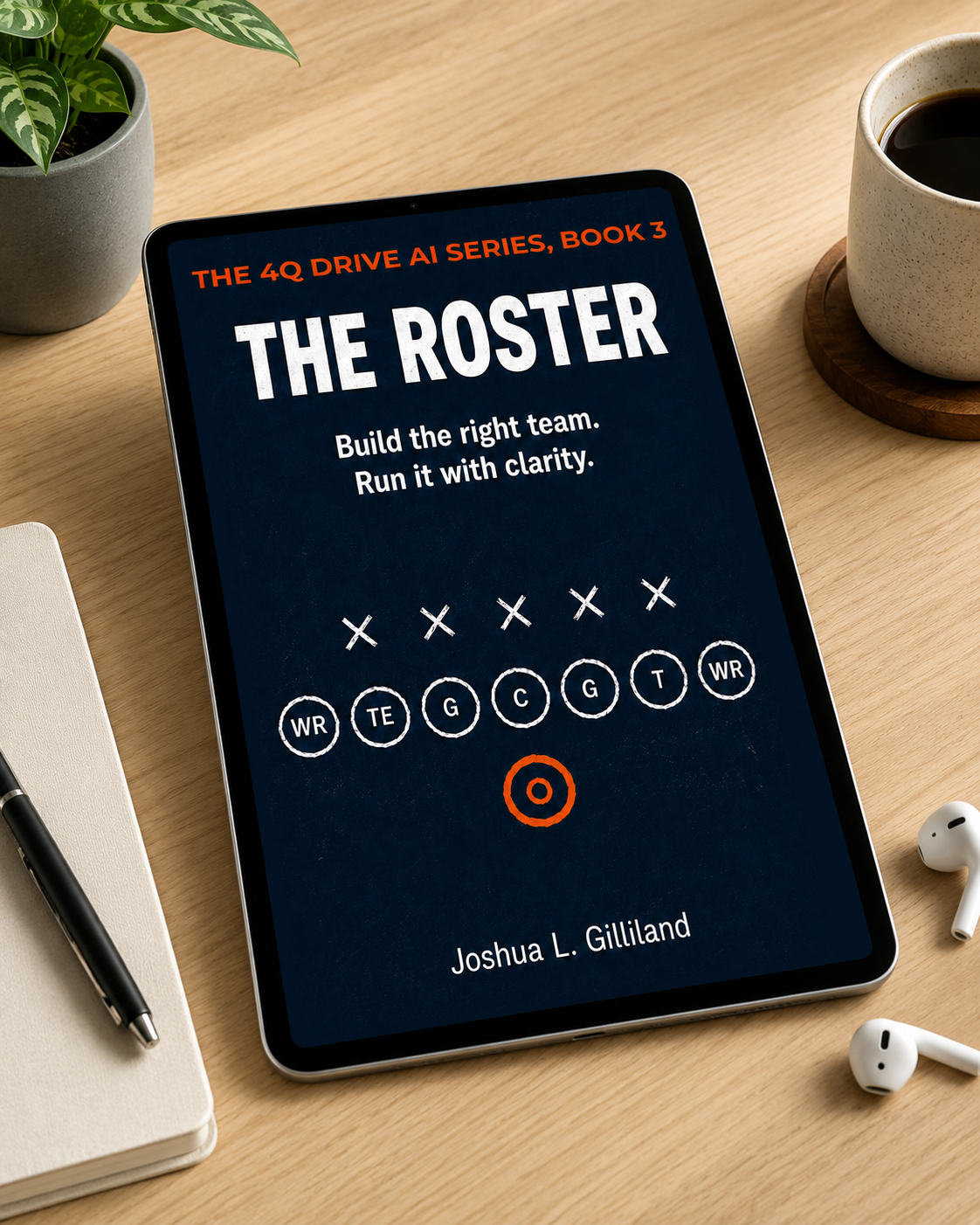
The Roster: Stop Re-Explaining Yourself to AI Every Time
$20 — book and workbook
The team you direct, built deliberately.
Most people use AI as a string of one-off prompts. Every session starts from zero. You paste the same background, explain who the work is for, get something usable, and tomorrow you do it all again. It works, and it feels like onboarding a new temp every single morning, one who forgets everything the moment they leave.
You already know the better way, because you ran operations. You did not re-explain the company to a colleague every day. They held a role. They knew the context and the standard, and you handed them the work and they ran. The Roster is how you build that out of AI instead of headcount: a set of briefed roles, each carrying the context and the quality bar for a recurring kind of work. A researcher who already knows your field. An editor who already knows your voice. You brief each one properly, once, and then you direct a team instead of re-teaching a stranger.
This is staffing, which is a thing you already know how to do. This book shows you how to do it with agents.
Inside The Roster
Why one generalist prompt produces mediocre work, and what a set of scoped roles produces instead.
The Briefing Document: how to brief a role once, with the context, examples, and constraints that make it reliable.
How the team holds up over time, where it breaks, and how it evolves as your practice does.
Contents
Chapter 1: Stop Hiring One Generalist
Chapter 2: The Roles That Matter
Chapter 3: The Roster Build
Chapter 4: Where Your Team Lives
Chapter 5: The Persistent Workspace
Chapter 6: Multi-Agent or Single Agent
Chapter 7: The Briefing Document
Chapter 8: Context, Examples, and Constraints
Chapter 9: Positive Friction in Practice
Chapter 10: Daily Brief
Chapter 11: When the Team Breaks
Chapter 12: The Roster Evolves
What you get
The complete book in EPUB and PDF.
The Roster workbook, which walks you through building your first roster of briefed roles, with the briefing documents to run them.
A guide to the full 4Q Drive system, showing how all five books fit together.
The lesson is not "AI is unreliable." It is about your discipline, not the tool.
It would be easy to file this under "AI breaks," but that is the wrong read. The agent did not fail me. My maintenance did. The tool did exactly what it was going to do at its limit. The thing I controlled, keeping the standing documentation current so a handoff is cheap, is the thing I dropped.
This is the part of directing AI that nobody puts in the exciting posts. If you run agents that hold real context for real work, that context is an asset, and like any asset it has to be maintained. The debrief document, the standing record of what the agent knows and where things stand, is the thing that lets you survive an agent failing, filling up, or needing to be rebuilt. When it is current, a broken agent is a twenty-minute swap. When it is stale, it is an afternoon of archaeology followed by a week of catching errors from the gaps.
The rule I re-learned the hard way: update the debrief on a rhythm, not when you feel like it, and definitely not when you are already busy, because busy is exactly when the agent you are leaning on hardest is most likely to hit its limit. The maintenance you skip is the thrash you buy later.
I know this. I teach a version of this. And I still dropped it, because it is the boring discipline and the boring discipline is the easiest to let slide. Which is precisely why it is worth saying out loud.
