
Your AI Agents Are Building an Echo Chamber. Here Is How to Break It.
If you run your work through AI the way I do, you have probably built up a few agents that know your business. One holds the context for this part of the operation, another for that part. You have briefed them well. They know your standards, your history, your goals. That is the whole point, and it works.
It also has a failure mode that took me a while to see, because it hides inside the thing that makes the setup good.
An agent that holds all your context starts to reflect your context back at you. You brief it on how you think, and then it thinks that way. You tell it what the business is, and then it reasons from inside that frame. Ask it to evaluate a plan and it evaluates the plan the way you would, because you are the one who taught it how you would. Multiply that across a few agents that all hold versions of the same context, and you have built a room where every voice already agrees with you. It feels like counsel. It is closer to an echo.
Any experienced operator knows this pattern from the human version. A team that only talks to itself develops blind spots. The people inside a project lose the ability to see it the way an outsider would, because they have all absorbed the same assumptions. The fix in the corporate world is not subtle: you bring in someone from outside who does not share the context, and you let them ask the dumb questions and challenge the things everyone inside has stopped questioning. The outside review is how you find the blind spot the inside cannot see.
The same fix works on your AI, and this week I ran it deliberately.
The tactic
I stood up a brand new agent in a different tool from the one my main agents run in. Deliberately a different environment, so it shared nothing with them. No memory of my business. No history with me. No accumulated context. A blank, capable reasoner that knew nothing about who I was or how I thought.
Then I gave it very little. Just enough to get started, a short description of the business and the areas it covers. Not the full briefing I would give an agent I was putting to work. The goal was not to make it an expert on my operation. The goal was to keep it naive on purpose.
And then I let it interrogate me. It asked questions about the different business lines. Basic ones, the kind my established agents would never ask because they already have the answers baked in. I answered, and as I answered, it built its own understanding of the business from scratch, unshaped by the frame my other agents share. Then we walked through how the operation is actually set up, and I let it pressure test the whole thing.
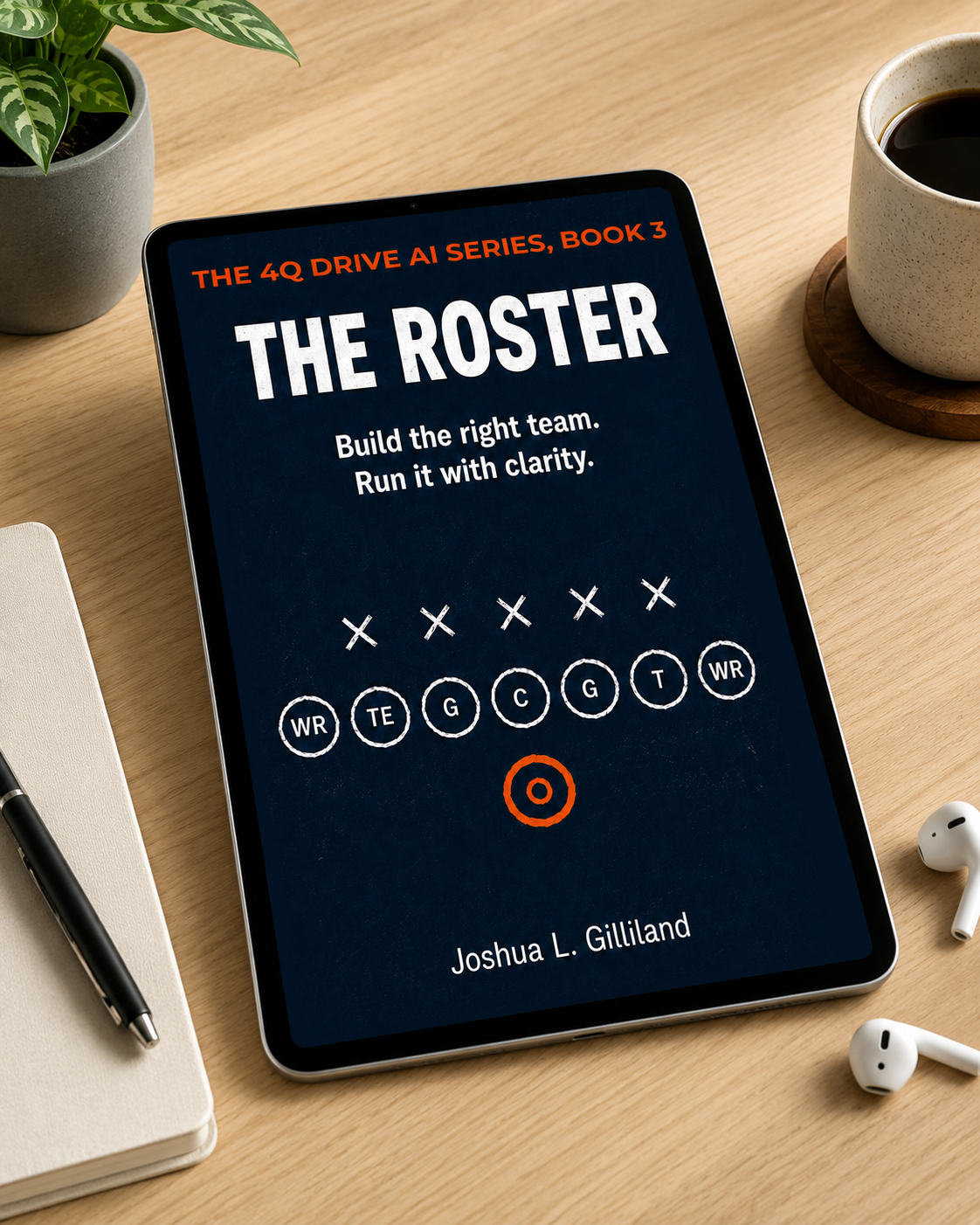
The Roster: Stop Re-Explaining Yourself to AI Every Time
$20 — book and workbook
The team you direct, built deliberately.
Most people use AI as a string of one-off prompts. Every session starts from zero. You paste the same background, explain who the work is for, get something usable, and tomorrow you do it all again. It works, and it feels like onboarding a new temp every single morning, one who forgets everything the moment they leave.
You already know the better way, because you ran operations. You did not re-explain the company to a colleague every day. They held a role. They knew the context and the standard, and you handed them the work and they ran. The Roster is how you build that out of AI instead of headcount: a set of briefed roles, each carrying the context and the quality bar for a recurring kind of work. A researcher who already knows your field. An editor who already knows your voice. You brief each one properly, once, and then you direct a team instead of re-teaching a stranger.
This is staffing, which is a thing you already know how to do. This book shows you how to do it with agents.
Inside The Roster
Why one generalist prompt produces mediocre work, and what a set of scoped roles produces instead.
The Briefing Document: how to brief a role once, with the context, examples, and constraints that make it reliable.
How the team holds up over time, where it breaks, and how it evolves as your practice does.
Contents
Chapter 1: Stop Hiring One Generalist
Chapter 2: The Roles That Matter
Chapter 3: The Roster Build
Chapter 4: Where Your Team Lives
Chapter 5: The Persistent Workspace
Chapter 6: Multi-Agent or Single Agent
Chapter 7: The Briefing Document
Chapter 8: Context, Examples, and Constraints
Chapter 9: Positive Friction in Practice
Chapter 10: Daily Brief
Chapter 11: When the Team Breaks
Chapter 12: The Roster Evolves
What you get
The complete book in EPUB and PDF.
The Roster workbook, which walks you through building your first roster of briefed roles, with the briefing documents to run them.
A guide to the full 4Q Drive system, showing how all five books fit together.
Because it did not know how I think, it did not reason the way I reason. It pushed on things my other agents had stopped questioning. It found the assumptions that had gone invisible from the inside. None of what it surfaced was dramatic. A few structural things I had drifted past. A couple of places where the setup made sense only because I was used to it. Small corrections, but real ones, and every single one was something I would not have caught by asking an agent that already agreed with me.
I took those back to my established agents and rolled out the changes.
Why this is an operator's move, not a tech trick
The instinct behind this is not technical. It is the same judgment you have used your whole career: the people closest to the work cannot see the work clearly, so you deliberately introduce an outside perspective that does not share the blind spots. You already know how to do this with people. Directing AI well means doing it with agents too.
The setup that makes your AI useful, agents that deeply hold your context, is the exact setup that produces the echo chamber. So the discipline is to periodically break your own silo on purpose. Stand up a naive agent in a different environment. Give it little. Let it ask the questions your experts have stopped asking. It costs you an hour, and it gives you back the one thing your well-briefed agents structurally cannot: a view from outside the frame you built.
Your agents are good at telling you what you already know. Once in a while, you need one that does not know it yet.
